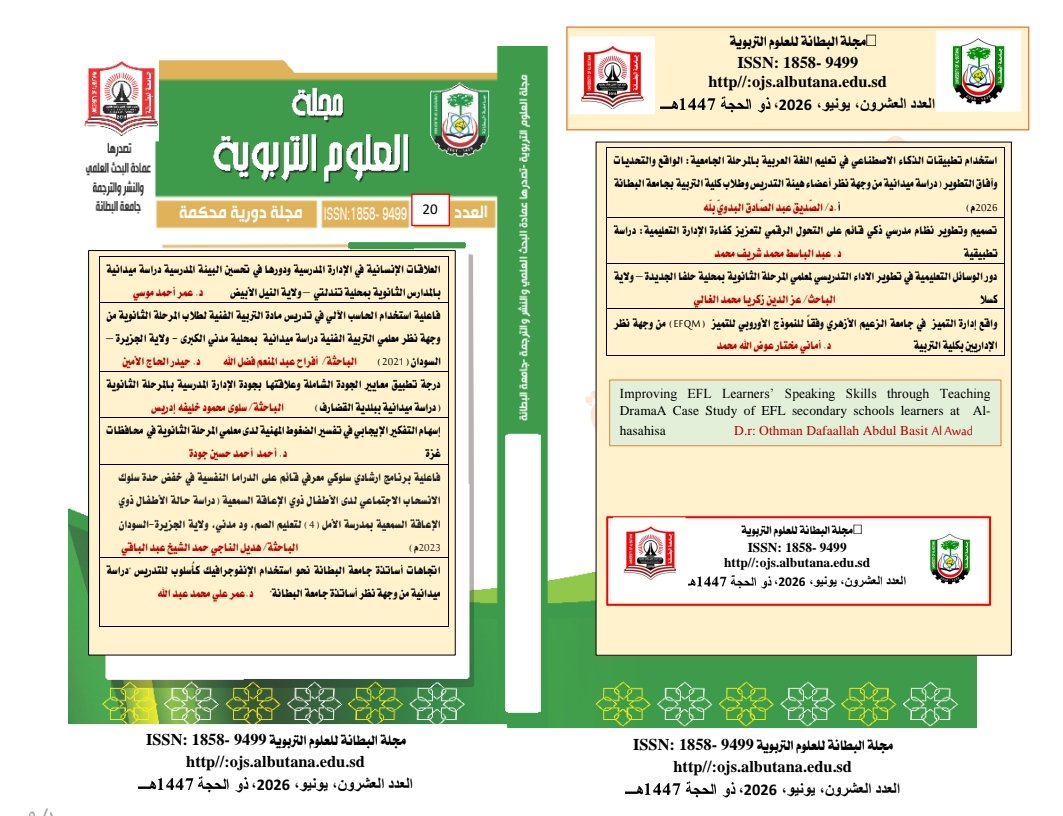
تصميم وتطوير نظام مدرسي ذكي قائم على التحول الرقمي لتعزيز كفاءة الإدارة التعليمية:دراسة تطبيقية في مدرسة العودة بجمهورية السودان-الولاية الشمالية-دنقلا، من وجهة نظر الكادر الإداري وأولياء الأمور للعام2026م
الكلمات المفتاحية:
Digital Transformation, Smart School Administration, Al-Awda Primary School, Hybrid Cloud Computing, Google Apps Script, WhatsApp Business API.الملخص
The study aimed to design and develop the "Al-Awda Smart School System" as an applied model
based on digital transformation technologies to enhance educational administration efficiency,
automate administrative and financial processes, and develop instant communication channels at Al-
Awda Primary School in Dongola (Northern State - Republic of Sudan). The study adopted the
Research and Development (R&D) methodology. The study was conducted during the 2026
academic year on a total sample of (35) participants, divided into: a purposive total population sample comprising (5) administrators and accountants to evaluate the system's functional efficiency,
and a simple random sample of (30) parents to measure the effectiveness of instant communication
tools. The study's tool and developmental material consisted of building a hybrid software system
that integrates client-side local storage with cloud connectivity via Google Apps Script and Google
Sheets as a centralized database, alongside activating an event-driven automated notification
mechanism through the WhatsApp Business API. For data analysis, descriptive statistical methods
(frequencies, mean scores, standard deviations, and percentages) were utilized, processed
programmatically via the system's real-time engine. The study yielded several key results, most
notably: The system successfully automated operations, reducing the time required to register new
students by 86.6%, cutting the time for calculating tuition fees and issuing financial receipts by
90.0%, and accelerating grade recording and GPA extraction by 93.3%, with comprehensive reports
generated instantly, achieving a time-reduction rate of 98.3%. Furthermore, automated reminder
notifications increased parents' payment compliance rate by 38%, and the system achieved a 92%
satisfaction and response rate among parents regarding instant communication, while ensuring
100% business continuity and data persistence during temporary internet outages at the school by
relying on local storage technology. In light of these findings, the study recommended: The
necessity of adopting low-cost hybrid software architectures as sustainable and economic
alternatives in schools with limited technological infrastructure, and endorsing automated instant
messaging interfaces as official channels to eliminate organizational distance and foster effective
parental partnership