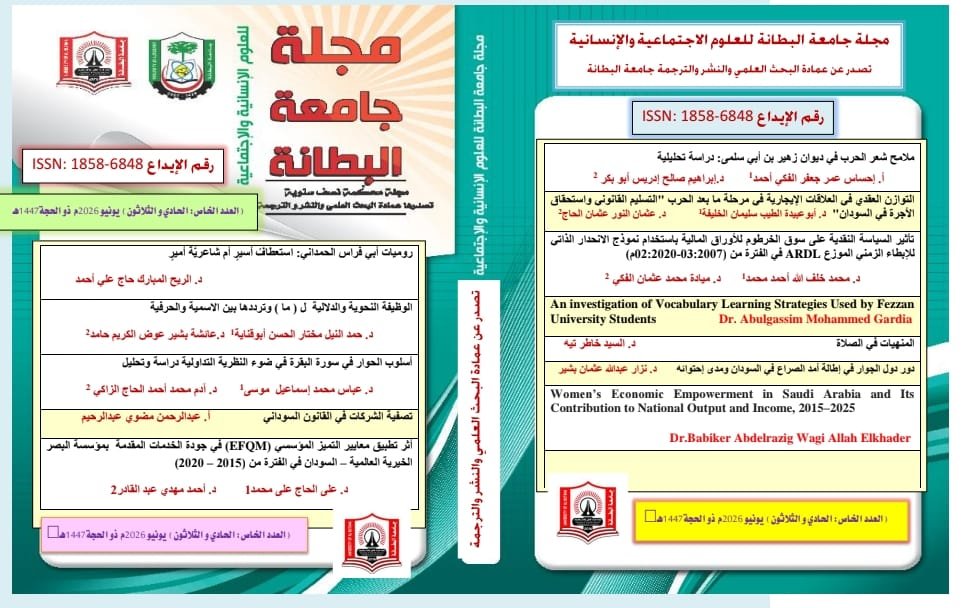
التوازن العقدي في العلاقات الإيجارية في مرحلة ما بعد الحرب "التسليم القانوني واستحقاق الأجرة في السودان"
DOI:
https://doi.org/10.12345/jhss.vi31.353Keywords:
contractual equilibrium, lease contracts, rent entitlement, unforeseen circumstances, war, Sudanese law, Islamic jurisprudence, mediation and arbitration.Abstract
This study examines the legal implications of the war that broke out in April 2023 and forced
displacement on the enforceability of rent obligations in lease contracts under Sudanese law. It
analyzes the issue in light of the Civil Transactions Act of 1984 and the Buildings Lease Act of
1991, drawing upon Islamic jurisprudence and comparative law to provide a comprehensive understanding of the relationship between contractual obligation and actual enjoyment of leased
property. The study posits that rent entitlement is not a formal or abstract obligation, but a
reciprocal duty inherently dependent on the tenant’s ability to benefit from the leased premises.
It explores the application of the doctrine of unforeseen exceptional circumstances (Article 117
of the Civil Transactions Act), distinguishing between force majeure and hardship, and
concludes that most conflict-related cases fall within the latter category, thereby enabling
judicial intervention to restore contractual equilibrium and economic fairness. The study also
proposes practical mechanisms for post-conflict contractual adjustment, including judicial
modification of obligations, activation of mediation and arbitration, legislative reforms of lease
regulations, establishment of a national support fund for affected parties, and the development of
a digital system to register leases linked to the property registry. The paper emphasizes that
resolving post-conflict lease disputes goes beyond mere financial adjustment; it serves as a tool
to rebuild legal certainty, restore public trust, and promote social stability and justice in postconflict Sudan.